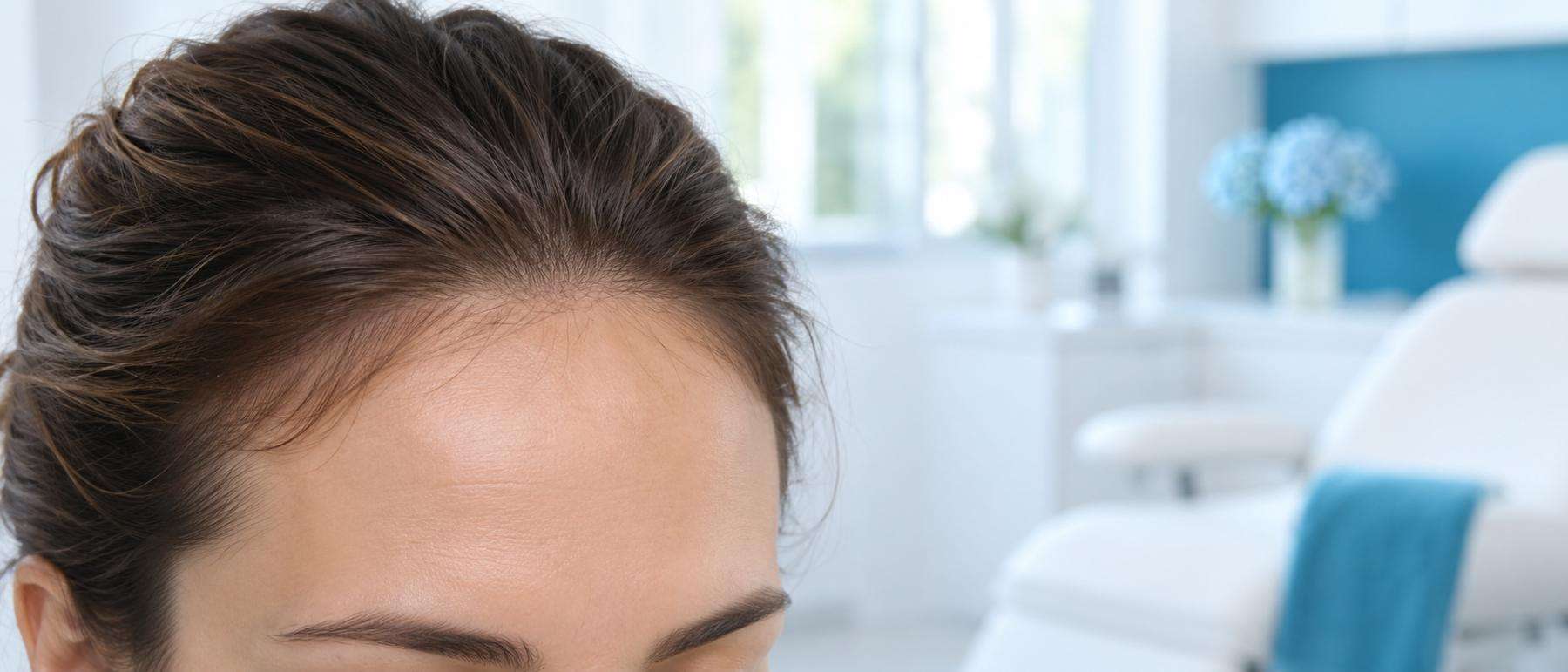
A high forehead is a matter of proportion: when the distance between the eyebrows and the hairline is long, the upper third of the face can look larger than the rest. Forehead reduction surgery, also called hairline lowering or hairline advancement, shortens that distance by moving the hair-bearing scalp forward. This guide explains how the operation works, who is a suitable candidate, how it compares with a hair transplant and what recovery involves.
Key points at a glance
- The hairline is moved forward in a single operation, usually by about 1.5 to 2.5 cm depending on how elastic the scalp is.
- The scar runs along the new hairline and is designed so that hair grows through it.
- The best candidates have a naturally high but stable hairline and no ongoing hair loss.
- A hair transplant can lower the hairline without a linear scar, but the result takes about a year to mature.
- Numbness of the scalp behind the incision is expected and normally fades over weeks or months.
In this article
What forehead reduction is
Forehead reduction is an operation that lowers the frontal hairline. A strip of forehead skin just in front of the hair is removed and the scalp behind it is advanced to close the gap. The eyebrows stay where they are: the forehead becomes shorter because the hairline comes down, not because the brows go up.
In most people a high hairline is a family trait that has been present since adolescence. It is different from a hairline that has moved back because of hair loss, which calls for a different approach. The procedure is requested far more often by women, whose hairlines tend to remain stable throughout life.
How hairline lowering works
The operation is planned with the patient sitting upright. The surgeon marks the new hairline on the forehead and checks how far the scalp can slide forward. The steps are then:
- Incision along the hairline. The cut follows a slightly irregular line just inside the first hairs and is angled so that the follicles at the edge are preserved and can later grow through the scar.
- Release of the scalp. The scalp is freed towards the back of the head so that it can move forward without tension.
- Removal of forehead skin. The strip of skin between the old and the new hairline is excised.
- Fixation and closure. The advanced scalp is anchored in its new position and the incision is closed in layers.
The procedure usually takes around two hours and is performed under general anaesthesia or deep sedation. How far the hairline can be moved depends above all on scalp elasticity. Published series report an average advancement of about 2 cm. When a larger change is needed, some surgeons stretch the scalp beforehand with a tissue expander, in a two-stage procedure.
Forehead reduction is not a brow lift
The two operations are often confused. A brow lift raises eyebrows that have descended; a forehead reduction lowers the hairline and leaves the brows in place. They can be combined when both issues are present, which is one more reason why an examination in person matters.
Who is a candidate
The indication depends on the hairline and scalp far more than on the measurement of the forehead alone.
| Factor | Favourable | Less favourable |
|---|---|---|
| Hairline history | High since youth and unchanged over the years | Progressive recession or thinning |
| Family history | No pattern hair loss in close relatives | Marked hair loss in the family |
| Scalp elasticity | Scalp that slides easily over the skull | Tight scalp with little movement |
| Hair density at the front | Dense frontal hair that hides the scar | Fine or sparse frontal hair |
| Previous surgery | No earlier scalp operations | Previous coronal brow lift or scalp surgery |
| Smoking | Non-smoker | Active smoking, which impairs healing |
Men can be candidates only when the hairline is stable and there is no tendency to baldness. If the hair recedes after surgery, the scar is left exposed on the forehead. For men with ongoing hair loss, stabilising the loss and considering a transplant is generally the more prudent route.
Forehead reduction vs hair transplant
A hairline can also be lowered by transplanting follicles from the back of the head to the upper forehead. The two approaches reach the same goal in different ways.
| Aspect | Forehead reduction surgery | Hair transplant |
|---|---|---|
| How it works | The whole scalp is advanced | Individual follicles are implanted in front of the hairline |
| Timing of the result | Visible immediately | About 12 months for full growth |
| Density | Same as the natural hair | Depends on the number of grafts; may need a second session |
| Scar | Fine line along the hairline | No linear scar at the front |
| Shape of the hairline | Follows the existing outline; limited change at the temples | Shape and temples can be redesigned |
| Suitable when hair loss is ongoing | No | Yes, with an appropriate plan |
| Anaesthesia | General or deep sedation | Local |
The two can also complement each other: a small number of grafts placed along the scar or at the temples can soften the hairline after a surgical advancement. Which path makes sense is a clinical decision based on scalp laxity, hair characteristics and the amount of lowering required.
Recovery timeline
| Period | What to expect | What helps |
|---|---|---|
| Days 1–3 | Tightness of the forehead and scalp, swelling that may descend to the eyelids, a light dressing. | Rest with the head raised, cold compresses as instructed, prescribed pain relief. |
| Days 4–7 | Swelling and bruising fade. Numbness behind the incision is normal. | Gentle hair washing once allowed. No bending or lifting. |
| Days 7–14 | Stitches are removed. Many people return to work, with the scar covered by a fringe or hairstyle. | Avoid sun on the scar and strenuous activity. |
| Weeks 3–6 | Exercise is resumed gradually. Some temporary hair shedding near the incision can occur. | Patience: shed hairs normally regrow. |
| Months 3–12 | Hair grows through the scar, sensation returns and the scar matures and pales. | Sun protection and follow-up visits. |
Times are indicative and vary from person to person.
The scar
The scar is the main trade-off of this operation and deserves a frank discussion. It lies exactly at the junction between forehead and hair. Two technical details help to conceal it: an irregular, wavy outline that imitates a natural hairline, and a bevelled incision that lets hairs grow through and in front of the scar within a few months.
In most people with dense frontal hair the line becomes difficult to see. It can remain more noticeable in those with fine hair, with a strong contrast between hair and skin colour, or with a tendency to form thick scars. If needed, it can later be refined with a few hair grafts.
Risks and side effects
What can happen
- Numbness of the scalp – expected in almost everyone, because small sensory nerves are divided at the incision. It usually improves over weeks to months.
- Temporary hair shedding near the incision, which normally regrows; permanent loss is uncommon.
- Visible or widened scar – more likely when the closure is under tension.
- Bleeding, haematoma or infection – as with any surgery.
- Asymmetry or less lowering than hoped – when scalp elasticity is limited.
- Delayed healing – more frequent in smokers.
Contact your surgeon promptly in case of increasing pain, sudden swelling, fever or changes in the colour of the skin near the incision.
Frequently asked questions
How much can the hairline be lowered?
In a single operation, usually between 1.5 and 2.5 cm. The limit is set by how far your scalp can move forward without tension, which the surgeon tests during the consultation.
Is the result permanent?
The advancement itself is permanent. The hairline can still change in the future if hair loss develops, which is why stability of the hairline is assessed so carefully beforehand.
Does forehead reduction change the eyebrows?
No. The brows keep their position unless a brow lift is planned in the same operation.
Is the operation painful?
Most people describe tightness and a mild headache more than pain. Discomfort is generally controlled with ordinary pain relief for a few days.
Can I choose a hair transplant instead?
Often yes. A transplant avoids a linear scar and allows the temples to be reshaped, but it takes longer to show and depends on the quality of your donor hair. Some people are better suited to one option, some to the other.
When will the scar stop showing?
The line is pink for the first weeks and can be covered by the hair. Hair starts to grow through it after about three months, and the scar continues to fade for up to a year.
The right approach depends on your hairline
At Clinica Pallaoro in Padua, a consultation is the moment to examine the hairline, the scalp and the quality of the hair, and to understand whether lowering the hairline is appropriate for you and with which method. You will receive clear information on options, recovery and risks, with time to ask your questions.
Medical sources
- Facial Plastic Surgery Clinics of North America, 2013 – Hairline lowering (review).
- Prospective cohort study, 2021 – Primary aesthetic hairline lowering (forehead reduction): technique, outcome and patient satisfaction.
- Aesthetic Plastic Surgery, 2025 – Forehead Reduction: A Retrospective Study of 820 Consecutive Cases.
- Plastic and Reconstructive Surgery, 2019 – Multiplane Forehead Shortening: Sparing the Frontal Muscle and Supraorbital Nerve.
- Facial Plastic Surgery, 2024 – Forehead Reduction Surgery with Hairline Advancement.
This article is for general information and does not replace a medical consultation. Indications, technique and recovery times are established by the surgeon after an individual assessment.